A Border Inside the Body: Cirebon-Indramayu Migrant Worker Between Presence and Distance
Article by:
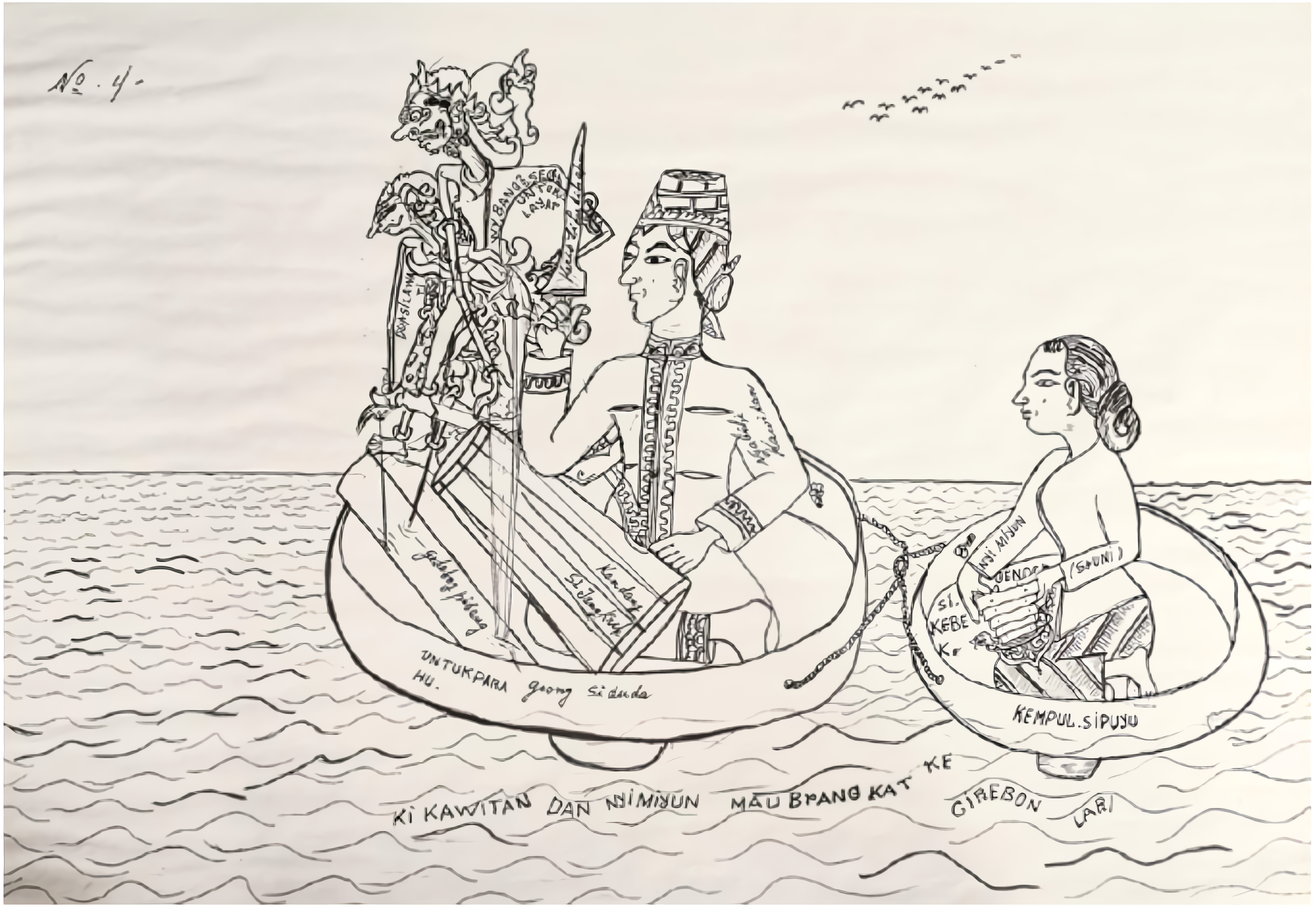
The puppeteer escapes Mataram to Kasepuhan. Drawing: Kandeg Patmadjawinata. Credit: Skip La Plante.
“Duh jeng ibu dalem nyuwun pamit. Bade majeng mring front”
—Macapat Cirebon, Mijil (Pelog)
“Borders are set up to define the places that are safe and unsafe, to distinguish us from them. A border is a dividing line, a narrow strip along a steep edge. A borderland is a vague and undetermined place created by the emotional residue of an unnatural boundary”
—Gloria Anzaldúa, Borderlands/La Frontera
As Mama Kandeg imagines in his painting of Ki Miyun fleeing Mataram across the Java Sea with his wife, home is not merely a fixed space. For performing artists (especially mask puppeteers), home is imagined as something portable—carried in masks, mask boxes, and other objects of performance. This concept articulates home as something that transcends geography itself, and instead emphasizes a relationship in which memory, tradition, and the spiritual are intertwined. Home is not merely a place to leave behind or return to, but rather something that can be carried, nurtured, and reinterpreted on every journey. Once home is understood as something mobile, separation from it appears less as a rupture than as a condition of movement itself. This forces one to find new ways to carry ‘home’ through objects or memories when the space once called home can no longer be fully inhabited.
In the traditions of the Nusantara peoples, including those of Cirebon and Indramayu, such mobility or migration is often referred to as merantau: a journey that makes the return home possible. These voluntary, culturally rooted journeys serve multiple purposes: seeking a livelihood, building independence through a rite of passage, gaining knowledge, expanding trade networks, or surviving. All of this is done with the understanding that it is not the person who crosses the border, but the border that crosses the person. However, when the possibility of a return journey begins to fade, mobility takes on a different meaning—it becomes a form of economic displacement, compelling people to leave home for years at a time. At this point, memory becomes the only place where loss (always) finds its home.
What distinguishes mobility rooted in merantau is that it always preserves the possibility of return, both emotionally and spatially. No matter how far a person goes, home remains an imagined destination that can be returned to. However, the rise of transnational labour migration complicates this imagination. Mobility no longer occurs solely as a journey framed by tradition or life cycles, but also by labour market demands, recruitment networks, employment contracts, and transnational migration policies. Under these conditions, returning home carries its own complexities: it is no longer as simple as returning to one’s original place, and it turns one's relationship to home into something that must continually be negotiated, even during the journey itself.
In many ways, few regions in Indonesia have experienced such an intense shift in the meaning of ‘home’ as Cirebon and Indramayu. Over the past few decades, these two regions have consistently been among the largest sources of Indonesian migrant workers. Cirebon, for example, ranks fifth nationally, while Indramayu is the largest contributor of Indonesian Migrant Workers (PMI) in the country, both at the West Java provincial level and nationally. Hong Kong, Taiwan, Singapore, Malaysia, and other Middle Eastern countries have become destinations for their residents in response to mounting economic pressures. Far from dissolving family ties, these migrant networks often hold families together. In the village, extended families routinely share the work of raising children which is supported by remittances. For some families, this collective cross-border mobility has become part of the rhythm of daily life and livelihood—a tradition passed down across generations, both within and outside homes sustained across distance.
However, the home that has been painstakingly maintained from afar must face new challenges upon their return. The state, family, and society always assume that migration is over once someone successfully returns to their hometown. In reality, migration is a process that never truly ends, even after a work contract has officially concluded. For years, migrant workers have maintained their homes and memories of them through remittances, caring for their families from afar, and even nurturing relationships so they do not feel uprooted. Yet what they encounter upon returning is something different. Instead of finding the home as it was preserved in their memories, they encounter a home that has changed, both socially and culturally, and that no longer resembles the home they had preserved in memory.
Just as a puppeteer preserves his home through mask performances, modern migrant workers preserve their homes through their daily practices. In the Cirebon artistic tradition kept alive by Mama Kandeg and Sanggar Setiya Negara, this mobility is embodied in the practice of bebarang, an itinerant tradition of traveling from place to place with mask boxes and performance gear to earn a living. Far beyond a mere economic survival strategy, bebarang is a path of collective care where a troupe of artists forms a mobile community, establishing a portable home wherever the stage is set. For modern migrant workers, transnational migration is their contemporary bebarang. Cell phones, remittances, and suitcases which are often packed hastily out of necessity, are their portable performance tools. Through these, they continue to perform acts of care and nurture kinship across national borders.
The state has systems for recruitment, placement, and the remittance of funds for every migrant worker. However, it lacks any system for return that ensures migrant workers can readjust to their communities. Return is something that is never prepared for, so the issue of migrant workers’ reintegration into their home environments is linked to the traumatic experience of migration. In fact, all the consequences that migrant workers must face after their return are part of the modern migration system itself.
Returning to one's hometown after years abroad often results in severe social disorientation, alienation, and unaddressed psychological trauma. Yet, the state views this return purely as an administrative matter rather than a complex human readjustment. In the absence of state care infrastructure, the burden of this crisis falls entirely on families within the domestic sphere. Lacking the language or resources to articulate these behavioral changes, families in Cirebon and Indramayu often misinterpret trauma as possession, mental illness, or a lack of faith. Consequently, post-return care devolves into social confinement or even physical restraint, transforming the home, once cherished from afar into a space that imprisons the migrant’s body.
In some ways, these conditions allow for a different kind of kinship, one outside the biological family that has long been tied to the traumatic experiences of migrant workers. As traditional kinship networks are stretched to their limits by the unaddressed trauma left by systemic state neglect, returned workers are forging hybrid, alternative communities. They attempt to build a shared home on the ruins of their shattered selves upon returning. Rather than replacing traditional extended kin, these peer-to-peer support circles act as ‘chosen family’ that extends care where structural support fails. Through this imagined and shared home, which transcends a mere physical structure, they are slowly building an informal care infrastructure, even if it is run by just two migrant workers, for instance. How many people are involved is certainly not the point. What matters most is how this 'home' can serve as a space to soothe the anxiety and trauma that are so often stirred up by an oppressive social system.
In the Cirebon performance tradition described by Mama Kandeg, where every performance eventually comes to an end, putting the masks back in the box, and carrying the ‘home’ across various borders, the migrant worker’s body never truly has a box in which to lay down the experiences of migration. They carry it home—along with a body that has become the dwelling place of various boundaries.